


Street Photography
How to Shoot Candid Street Portraits in Ashford Town Centre Without Being Noticed
September 14, 2026
There's a particular second in street photography when everything lines up: a face turning towards the light, a gesture half-finished, a stranger completely absorbed in their own morning. The moment they notice the camera, that second is gone. Ashford town centre is a good place to learn how to keep it. It's busy enough to provide a steady supply of people, compact enough to walk in a loop, and familiar enough that you can learn its rhythms — where the light falls at four o'clock, where people slow down, where nobody looks twice at someone standing still with a camera.
Start with manners, not tricks
Photographing in a public place in the UK is generally fine for personal and artistic work, but being allowed to do something and being welcome to do it are two different things. The photographers who get great candid work in a town centre are usually the ones who give people an easy way out.
Some habits worth keeping:
- Leave children alone unless a parent or carer can see what you're doing and is comfortable with it.
- If someone asks you to delete a frame, delete it. No discussion, no showing them the "good one".
- Skip anyone in distress — arguments, tears, medical moments, people sleeping rough. That's not a photograph, it's someone's bad afternoon.
- Remember that shopping centres, the station forecourt and most indoor spaces are private property with their own rules. Ask at the desk before you settle in.
- If you plan to publish, exhibit or sell an image where a person is clearly identifiable, get their permission. Model releases and commercial use are worth understanding properly, and if money or publication is involved, it's sensible to take proper advice.
None of this makes you timid. It makes you quick, because you're not spending your walk arguing with your own conscience.
Camera settings that get out of the way
Candid work rewards preparation and punishes fiddling. Set the camera up before you leave the house and change as little as possible once you're on the High Street.
A reliable starting point: aperture priority or manual, f/2.8 to f/4 when you want a single person isolated against the crowd, f/5.6 to f/8 when the setting matters as much as the face. Shutter speed of 1/250 as a floor, 1/500 if someone is walking towards you. Auto ISO with a ceiling somewhere around 3200 to 6400, depending on how much grain you like. Continuous autofocus with a single point or a small zone, not the full-frame scattergun mode that always picks the wrong shoulder.
Zone focusing, the old way
If your lens has a distance scale, try setting f/8 and focusing at roughly three metres. On a 35mm equivalent that puts most things from about two metres to eight metres in acceptable focus, which covers nearly every encounter on a pavement. Then you don't focus at all — you just lift the camera and press. It's faster than any autofocus system and it makes you far less conspicuous, because the camera is only at your eye for a fraction of a second.
Two more things. Turn on the silent or electronic shutter if you have it; the click of a DSLR mirrors a small announcement. And shoot in bursts of two or three frames, not ten. Three frames gives you a choice of expression. Ten makes you look like a paparazzo and takes an age to edit.
Techniques for staying unnoticed
Being unnoticed isn't about hiding. It's about being boring. A person standing still is furniture; a person creeping along a wall is a threat.
- Pick a spot and stay there. Five minutes in one place and the town stops registering you. People who walk past twice will assume you're waiting for someone.
- Shoot across the street, not head-on. A 35mm frame taken from the opposite pavement looks like a scene. The same face shot straight on from two metres looks like a confrontation.
- Use the flip screen. Camera at chest height, screen tilted up, eyes down. You look like you're checking a photo, which is exactly what you want.
- Aim past your subject. After the press, keep the camera up and sweep it towards a shop window or a building further along. Nobody can tell what you were actually framing.
- Work reflections and doorways. Shop glass, bus shelters and the deep doorways along Bank Street and Middle Row give you a place to stand and a second layer in the frame.
- Wait for the pause. People are most themselves when they stop — lighting a cigarette, checking a phone, queuing at a crossing, reading a menu board.
Keep the camera visible. A camera held openly at chest height reads as harmless. A camera half-hidden under a jacket reads as something else entirely.
The quiet corners worth knowing
The High Street is where the crowds are, but the crowds aren't automatically pictures. The best candid work tends to happen one street back, where people slow down.
Middle Row and Bank Street offer narrow, shaded passages with people walking through pools of light — good for single figures against dark backgrounds. The churchyard and memorial gardens are where people sit, read and eat lunch, which means stillness and expression rather than backs of heads. Lower High Street, heading towards the station, is quieter in the mornings and better in the afternoons when the light comes across the shopfronts.
Victoria Park is the outlier: not a shopping street at all, but a steady supply of walkers, dog owners, bench-sitters and people crossing the grass diagonally. The paths give you clean backgrounds. The bandstand gives you a natural stage. Elwick Place and the station approach are better after dark, when the lit windows and the glow of the crossings do half the work for you.
On market mornings, the High Street changes character entirely. Stalls create narrow corridors, people stop and turn, and faces get busy. It's the single best few hours of the week for this kind of photography, and also the busiest, so keep your framing simple.
Reading the light through the day
Overcast days are gifts. Even light, no squinting, no hard shadows carving up a face, and colour that stays consistent from one end of the street to the other. If the sky is flat grey, go out.
Bright days need a plan. Mid-morning and late afternoon are better than noon, when the sun sits overhead and puts eye sockets in shadow. In winter, low sun rakes straight down the wide streets and gives you long shadows and warm edges — but it also throws people into silhouette, so meter for the face and let the highlights go. Golden hour is short here and worth planning around. Position yourself so the light comes from behind your subject and slightly to one side, and expose for the face rather than the sky.
After the shutter
A nod, a smile or a lifted hand costs nothing and defuses almost everything. If someone catches your eye and looks uncertain, be ready with a plain sentence: you're photographing the town, and you're happy to delete it. Nine times out of ten they'll wave you on, and sometimes you'll get a proper portrait out of it.
A forty-minute practice loop
Start at the top of the High Street with your camera already set to f/5.6, 1/250 and auto ISO. Walk down to the memorial gardens and spend five minutes standing still at the edge of the path. Cut through to Middle Row and shoot the passage light for a few frames, then cross to Bank Street and wait by a doorway. Head down to Lower High Street, turn into Victoria Park, and finish by the bandstand. Forty minutes, one loop, no reviewing until you get home.
Do that once a week for a month and the town will start to feel like a studio you know — and the faces in it will stop noticing you at all.
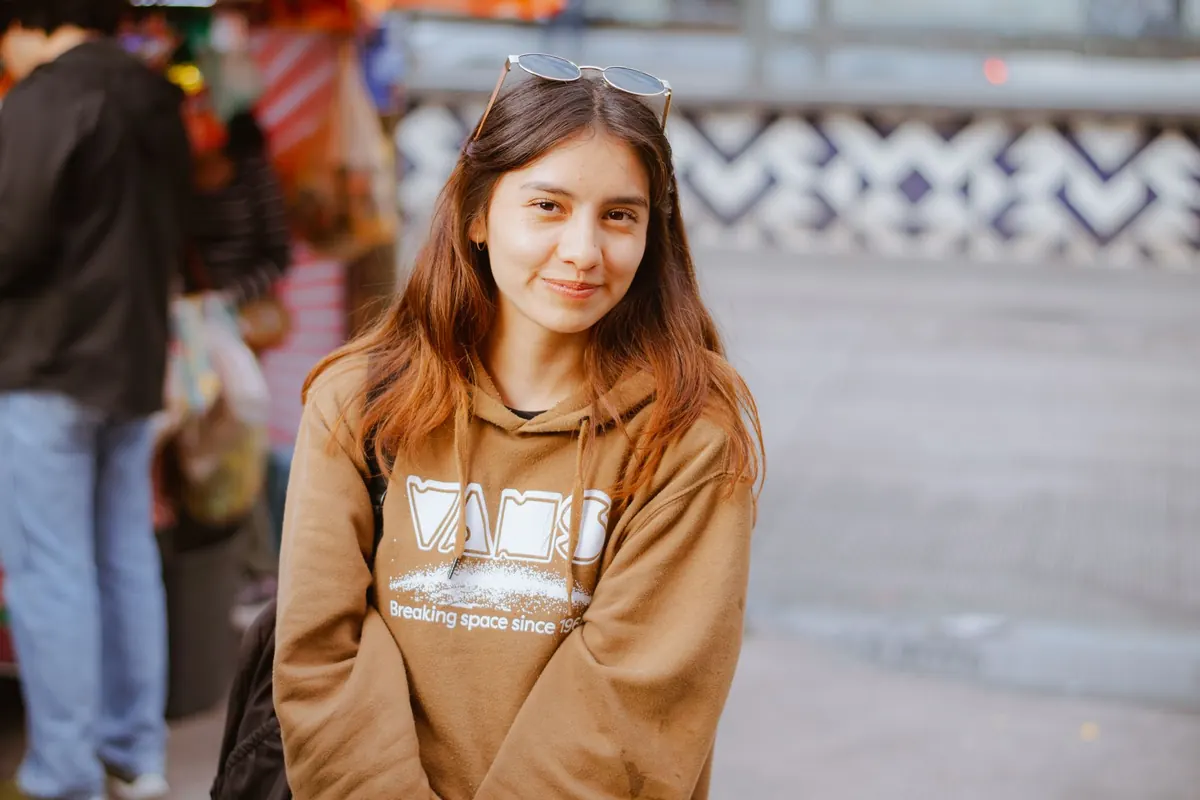
Photo: César O'neill / Pexels
Related posts
More stories you’ll love reading